If you’re a hardened traveler, you know travel experiences are influenced by a legion of factors. Sometimes, the stars align and your vacations empower, enlighten, and transform you into your ideal self. And other times, travel is overwhelming and quickly degrades into type-three fun.
To determine how positive your upcoming trip will be, you should evaluate your personality, perceptions of travel, and commitment to having a good vacation, says Dr. Ulrike Gretzel, the director of research at Netnografica and an expert on how personality affects travel and tourism.
“There is a lot of evidence in the literature that personality matters for positive travel experiences — the more open someone is to experience and the less neurotic the person is, the more likely they are to have a good experience,” Gretzel says.
Why Personality Types Matter — And Why We Use Them at Kalon Surf
Although deciphering personality is more of an art than an exact science, unraveling your emotional predispositions can help you decide what travel environments you might thrive in.
The most popular way to quantify a person’s personality is the Myers-Briggs system, which breaks down behaviors into four opposing preferences:
- Extraversion (E) vs. Introversion (I)
- Sensing (S) vs. Intuition (N)
- Thinking (T) vs. Feeling (F)
- Judging (J) vs. Perceiving (P)
Discover your personality type by taking this free test from 16 Personalities.
At Kalon Surf, we didn’t discover this framework through a business book — it came from family. My brother Arvid shared the 16personalities.com test with us when he was joining the Flying Doctors in Australia. He found it fascinating, and ever since, we’ve used it at Kalon Surf — not just for travel planning, but for building our team.
Having a certain personality type doesn’t mean someone is disqualified from anything. Instead, it helps us understand who you are and whether a role is the right fit (or if a different one would be better), approach feedback in a way that matches your communication style, and understand the friction that can happen between people with opposite personalities.
When I talk about personality, I don’t mean being “bubbly.” I’m talking about the core dimensions: extraversion vs. introversion, sensing vs. intuition, thinking vs. feeling, and judging vs. perceiving. All of that is incredibly important because some jobs link better with certain personality types.
I started Kalon Surf with my wife with the philosophy of making people happy — both our guests and our employees. It doesn’t help me, and it doesn’t make me happy, to know my employees aren’t enjoying their work. It also doesn’t help our guests when employees are in roles that aren’t the right fit. When you get someone with the right personality in the right job, they can do more than they ever thought possible.
The same principle applies to travel. Not every personality type will enjoy every type of vacation. But by understanding your preferences and general attitudes, you can plan your next adventure accordingly.
Sensing vs. Intuition
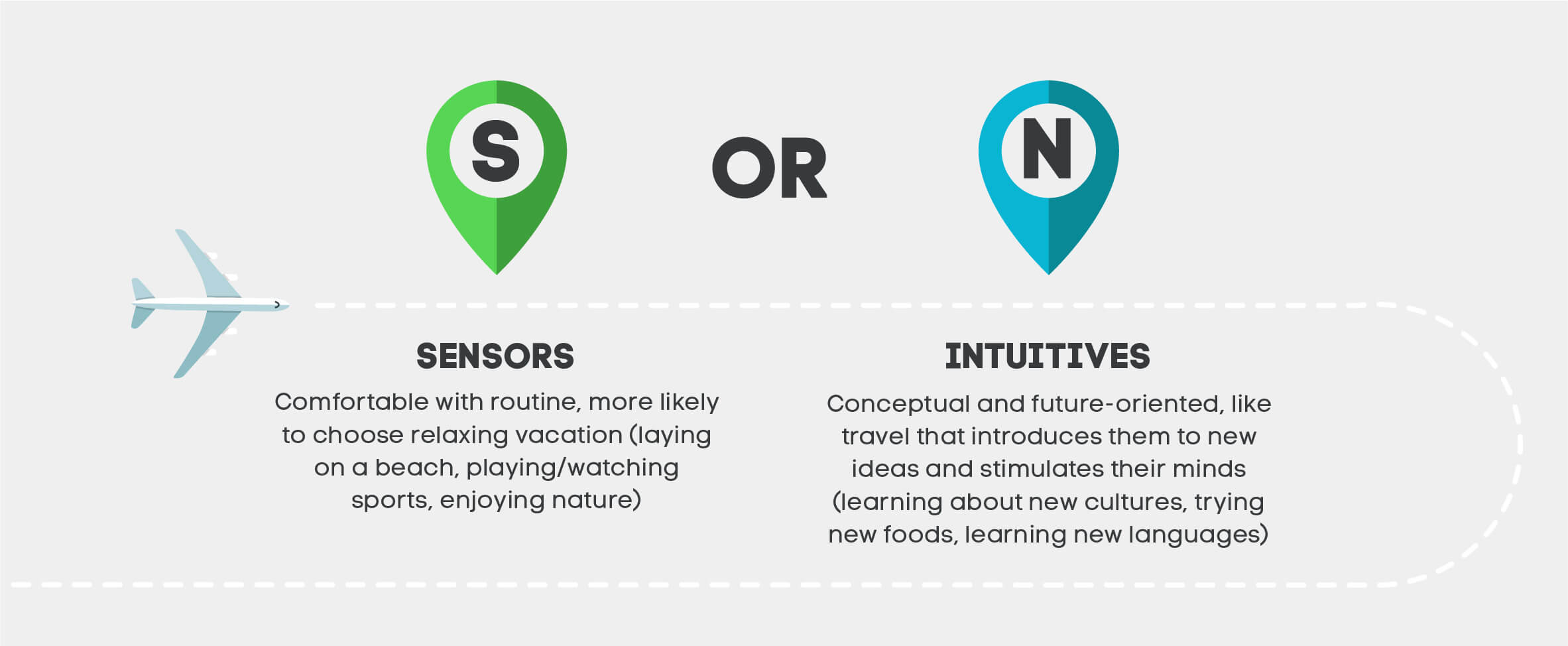
When it comes to travel, the most important personality dimension is your sensing vs. intuition preference, says Molly Owens, the CEO of Truity, a company that develops personality assessments based on the Myers-Briggs theory.
“Sensors tend to be more concrete and comfortable with routine, so they’re more likely to choose relaxing vacations that are focused on simple pleasures — laying on a beach, playing or watching sports, or enjoying nature,” Owens says. “Intuitives, on the other hand, are more conceptual and future-oriented, so they like travel that introduces them to new ideas and stimulates their minds.”
Judging vs. Perceiving
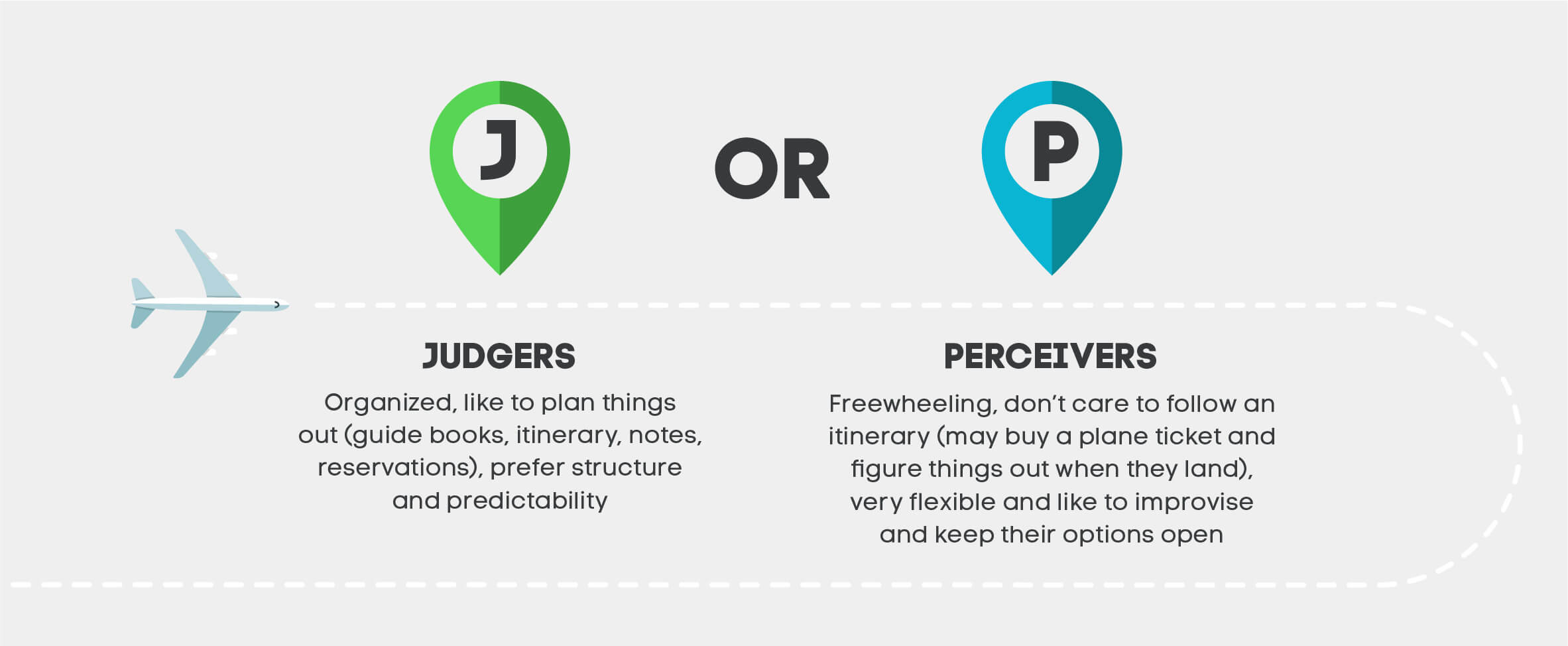
After deciding what type of itinerary you’re considering, judging vs. perceiving is the next personality factor to consider — especially if you plan to travel with other people.
Judgers are planners who book tickets and reservations way ahead of time, and whose guidebooks are smothered with dog-ears and notes. Whereas perceivers are more go-with-the-flow types who are okay with rolling the dice on a travel idea and leaving the rest up to chance.
“These personality differences can actually cause a lot of conflict among people who travel together,” Owens says. “Perceivers find the judger’s approach rigid and limiting, while the perceiver’s approach causes judgers no end of anxiety.”
Introversion vs. Extraversion
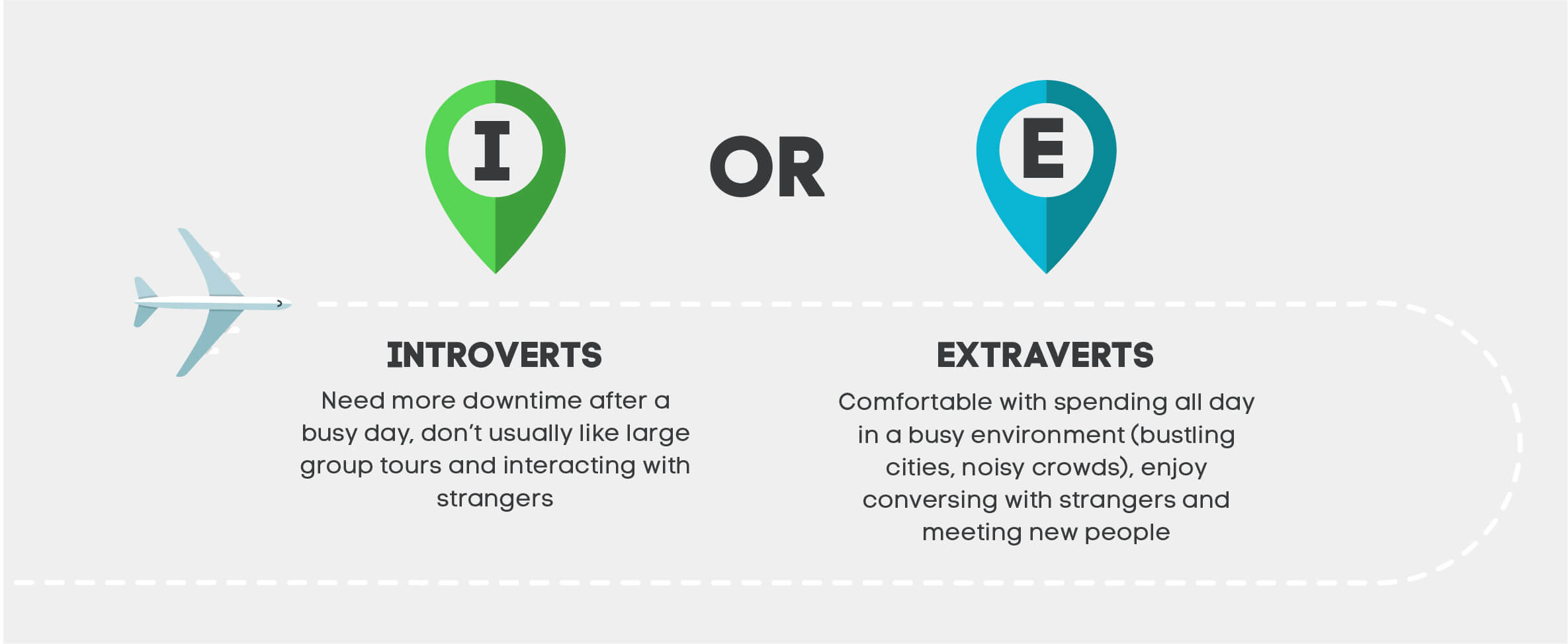
The third important personality factor is whether you’re an introvert or an extravert. Although extraverts and introverts may enjoy similar vacation ideas, there are significant differences in how they approach the day-to-day travel experience. The more notable difference is stimulation tolerance.
Extraverts are much more comfortable with stimulation, so spending all day in a busy city or a noisy crowd of tourists won’t bother them as much as it will introverts, who will need more downtime in between these types of excursions.
“If your vacation involves a lot of interacting with strangers — a tour group, or communicating with locals to find your way around — introverts will wear out a lot quicker than extraverts,” Owens says. “Extraverts might actually find it exciting to try and make conversation with lots of people along their travels, where introverts will generally find this exhausting.”
Thinking vs. Feeling
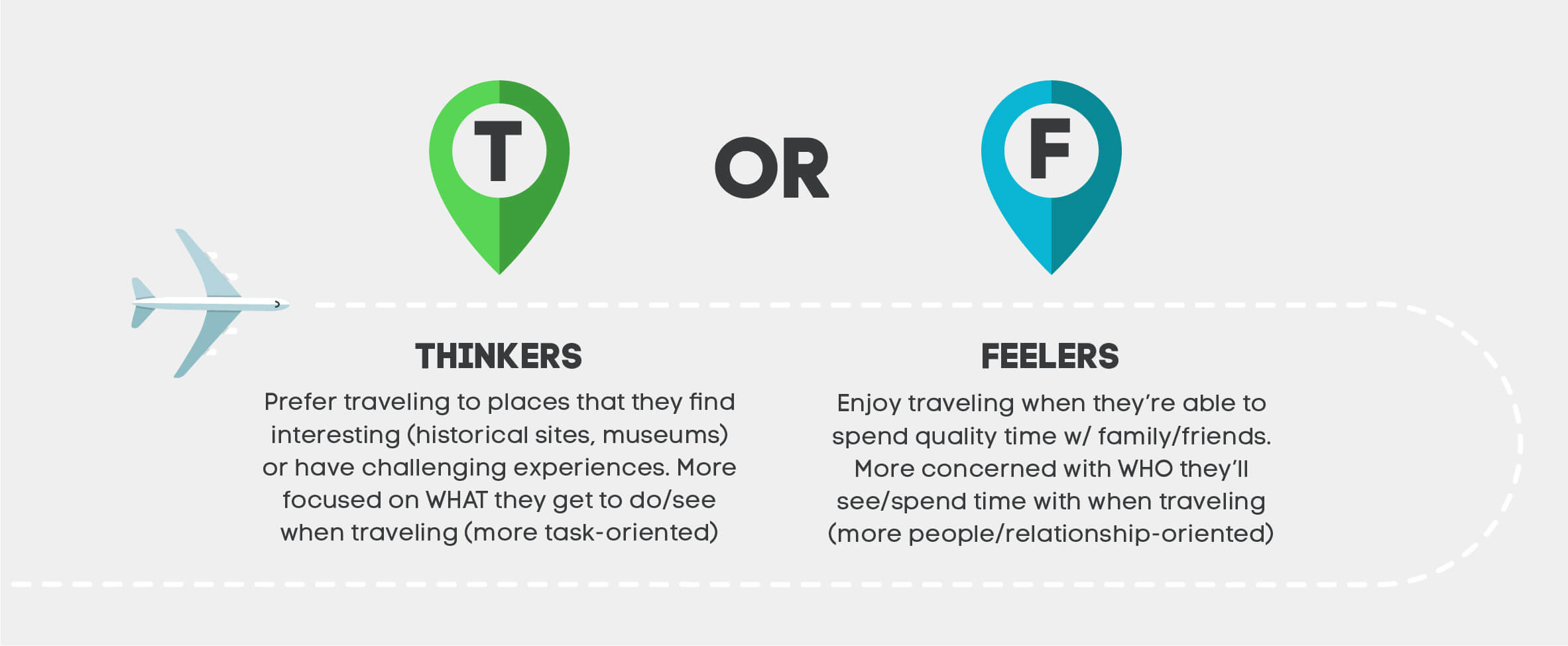
The final Myers-Briggs factor to consider is thinkers vs. feelers. Although each type may enjoy the same type of vacation, a thinker’s travel motivations are likely different than their feeler counterpart.
“Feelers often love to travel because it allows them to spend quality time with their families or visit loved ones they don’t often get to see,” Owens says. “Thinkers are more likely to want to visit places that interest them intellectually, like museums or historical sites, or have travel experiences that challenge them in some way.”
Your personality type also influences how often you’ll need a vacation, and what type of preparations you should take in advance.
If your combination of the Myers-Briggs traits means you’re an INFJ, INTJ, INTP or INFP, you’re more likely to succumb to daily stressors and need to take a break and escape the chaos more frequently, says Rob Williams, a personality test design specialist with Rob Williams Assessment Ltd. Conversely, Williams says if you’re an ENTP, ESTP, ENFP or ESFP, you’re less likely to need frequent vacations because you’re predisposed to be more resilient against stress.
After you diagnose your personality type and couple it with how you manage things like stress, fear, anxiety, and new experiences, you can paint a picture of your travel persona. This persona can guide you during your travels, but keep in mind that it will likely evolve. If your vacations mirror who you are and foster personal growth, you’ll learn to travel better while developing the resilience and attitude that Gretzel says are crucial to have a rewarding vacation. By being mindful of your travel persona, you can engage in intentional travel for personal growth, making choices that align with your values and aspirations.
But before you book your ticket and wander through a stuffy airport, sleep-deprived and hangry, consider if your itinerary complements your personality type.
How the 16 Myers-Briggs Personality Types Should Travel
Your personality influences what type of vacation you prefer, and it also affects your activities, how you get around, and who you bring along. Below are how each Myers-Briggs personality type prefers to travel and where they should consider taking a vacation.
Analysts
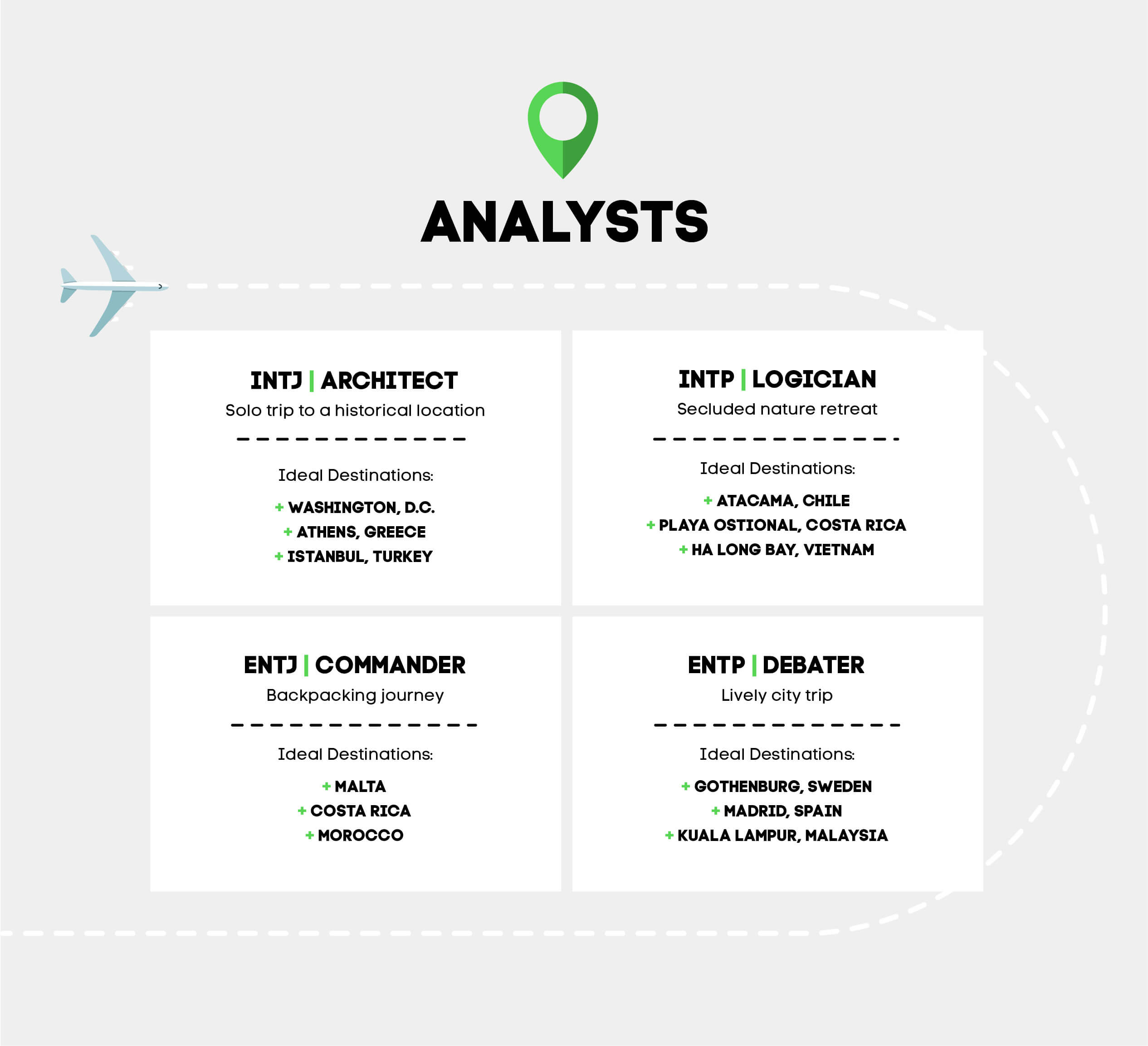
INTJ / Architect
As an INTJ, you don’t like waiting around for people and want to do things on your timetable. Solo travel can be a rewarding experience for you, as social environments will wear you out. Stay away from guided tours with large groups, and follow your own itinerary. If your itinerary requires a guide, look for companies that offer smaller, personal tour groups. You likely enjoy visiting historical locations and museums where you can soak up interesting facts and lesser-known tidbits of information.
Where INTJ should travel: Solo trip to a historical location
- Washington, D.C. — Lincoln Memorial, Smithsonian museums and galleries, National World War II Memorial
- Athens, Greece — Acropolis, National Archaeological Museum, Parthenon
- Istanbul, Turkey — Dolmabahce Palace, Hagia Sophia Museum, Suleymaniye Mosque
INTP / Logician
You’re constantly daydreaming about new ideas and like to keep your options open. You’d rather improvise and go where the wind blows you. If you’re going to interact with locals or other tourists, it’s best to travel with someone who knows you well because you can come off as shy and withdrawn when around new people. You crave new experiences, so look for opportunities to do something unique, whether it’s attending a cultural event, trying a new food or learning a new language.
Where INTP should travel: Secluded nature retreat
- Atacama, Chile — Las Piedras Rojas, Valle de la Luna, Termas de Puritama
- Playa Ostional, Costa Rica — Ostional Wildlife Refuge, beaches, wetland kayaking tour
- Ha Long Bay, Vietnam — Hang Sung Sot Cave, Cat Ba Island, Cat Co 3 beach
ENTJ / Commander
If there’s ever a challenge, you’re the first to step up to the plate. You’ll thrive during your trip if you create a detailed travel itinerary, which lets you maximize your time and know what to expect each day. It doesn’t matter if you’re alone or with friends. Much like your home life, you’ll have no problem meeting new people on your journey.
Where ENTJ should travel: Backpacking journey
- Malta — Mdina, Fort St. Elmo, Comino
- Costa Rica — Arenal Volcano, Osa Peninsula, Puerto Viejo de Talamanca
- Morocco — Fez, Chefchaouen, Sahara Desert
ENTP / Debater
Whether you’re chatting with your best friend or a crowd of strangers, you have no problem starting an interesting conversation. It’s best if you visit busy places with lively social environments and lots of opportunities to mingle with locals. You’ll likely enjoy your trip more if you don’t make concrete plans, and instead ask locals for advice on what to do and where to go.
Where ENTP should travel: Lively city trip
- Gothenburg, Sweden — Avenyn, Liseberg, Stora Saluhallen
- Madrid, Spain — Puerta del Sol, Gran Vía, Plaza Mayor
- Kuala Lumpur, Malaysia — Sunway Lagoon, KLCC Complex, Alor Street
Diplomats
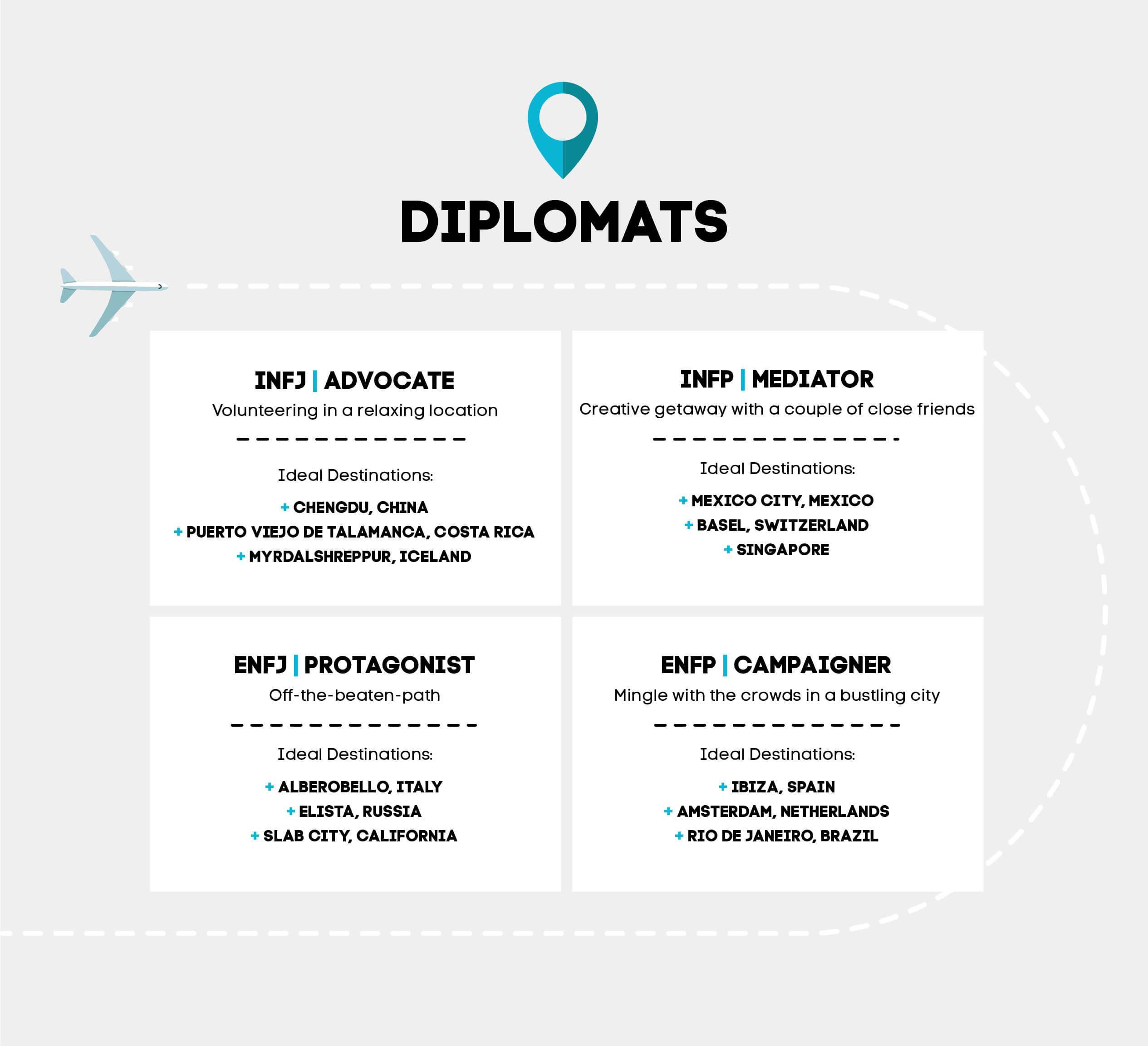
INFJ / Advocate
While you enjoy helping others, you also need to take time for yourself to unwind. Limit yourself to traveling with a few close friends or family members who understand that you’ll need some downtime by yourself to recharge. Choose a calm destination that will still provide you with humanitarian service opportunities — just make sure you plan out your days so you can get a good balance between serving others and relaxing.
Where INFJ should travel: Volunteering in a relaxing location
- Chengdu, China — Volunteer at the Giant Panda Center, Wenshu Yuan Monastery, Mount Qingcheng
- Puerto Viejo de Talamanca, Costa Rica — Volunteer at El Puente (a school for children with learning disabilities), Finca La Isla, Aiko-logi
- Myrdalshreppur, Iceland — Volunteer on a cow and carrot farm, Reynisdrangar, Reynisfjall
INFP / Mediator
You’re probably caught daydreaming quite often, and where you travel shouldn’t change that habit. Choose destinations that are full of colors and creative cultures that feel like one of the fantasy worlds you’ve imagined. Travel with people who mean something to you, but keep your group small as you may become overwhelmed in a large group setting. Don’t make too many plans in your itinerary, and take time to express yourself when you’re feeling inspired.
Where INFP should travel: Creative getaway with a couple of close friends
- Mexico City, Mexico — Palacio de Bellas Artes, Basílica de Santa María de Guadalupe, Museo de Arte Popular
- Basel, Switzerland — Kunstmuseum Basel, Basel Minster, Rathaus
- Singapore — Supertree Grove, Jurong Bird Park, Gardens by the Bay
ENFJ / Protagonist
If you’re going on vacation, make sure it’s exotic and exhilarating. You should organize your trip well and make plans far in advance, especially if you’re traveling with a big group. It’s important to you that everyone sees and does what they want, so you’re willing to compromise and give up doing what you want in favor of others. But be careful not to sacrifice too much — it’s important that you enjoy yourself just as much as everyone else.
Where ENFJ should travel: Off-the-beaten-path
- Alberobello, Italy — I Trulli di Alberobello, Parrocchia Sant’Antonio di Padova, Trullo Sovrano
- Elista, Russia — Buddha Shakyamuni Golden Abode, Palmov Kalmykia Republican Museum of Local Lore, Pagoda Seven Days
- Slab City, California — Salvation Mountain, The Range, Hot Springs
ENFP / Campaigner
You’re a free spirit and have no reason to make or follow plans while traveling. Visit somewhere that’s exciting and full of life with lots of people, whether they’re tourists or locals. Stick with a lively group, whether they’re longtime friends or new acquaintances you met in the hotel lobby. You may get overwhelmed with the flourish of new sights, sounds and faces, so be sure to take a break when you start feeling stressed.
Where ENFP should travel: Mingle with the crowds in a bustling city
- Ibiza, Spain — Playa D’en Bossa, San Antonio, Formentera
- Amsterdam, Netherlands — Jordaan, Museumplein, Westergas
- Rio de Janeiro, Brazil — Corcovado Christ the Redeemer, Ipanema Beach, football match at Maracanã
Sentinels
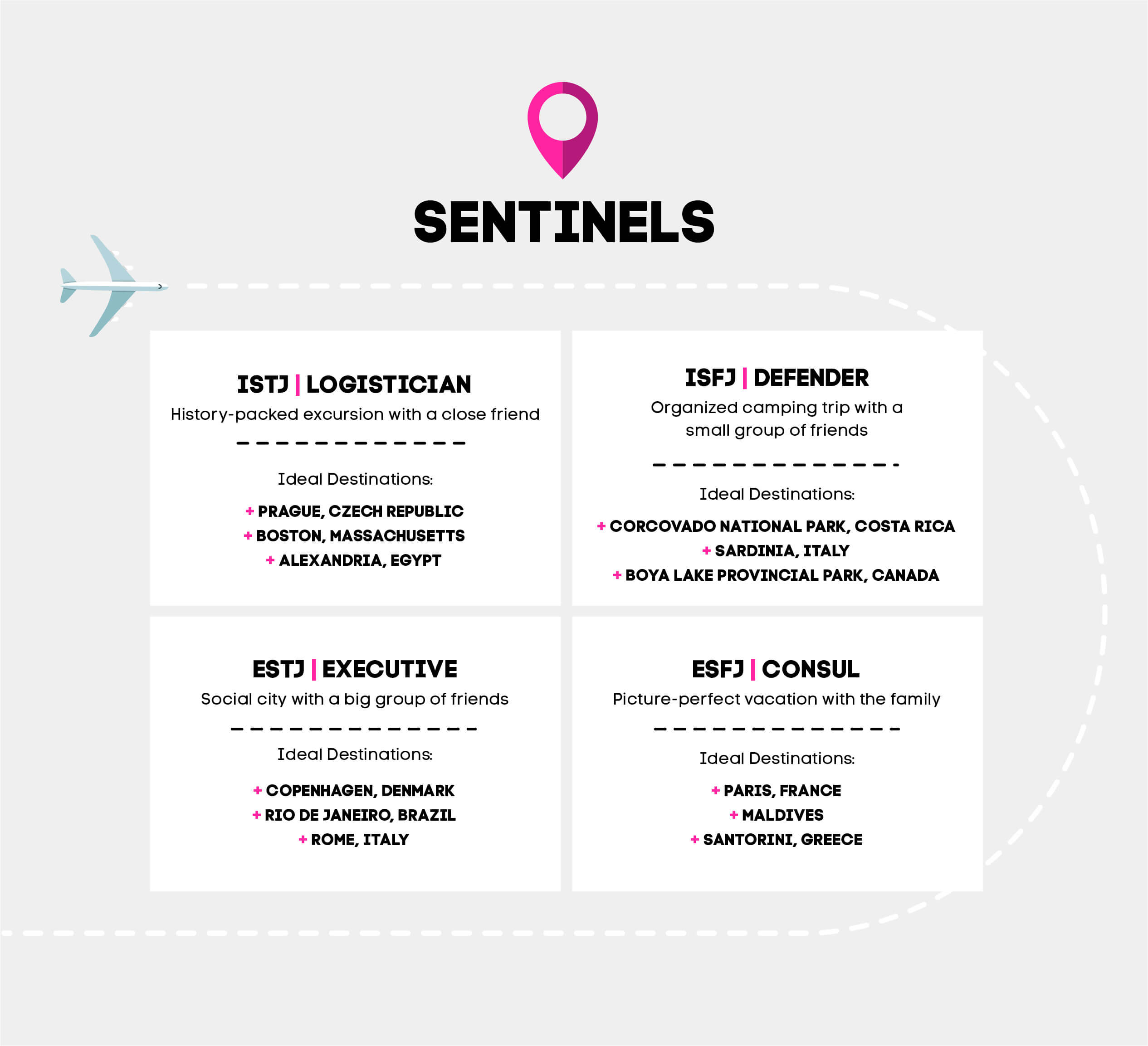
ISTJ / Logistician
Planning should be your first priority when traveling, so organize your days in such a way that you’ll get to see and do everything on your list. Traveling alone ensures you don’t have anyone interfering with your plans, but it’s alright if you want to bring one or two other people along. Make sure those who are traveling with you know what the plan is and are prepared to follow it. But if your plans don’t quite go accordingly, don’t get too frustrated — you’ll still see and do more than most people.
Where ISTJ should travel: History-packed excursion with a close friend
- Prague, Czech Republic — Josefov, St. Vitus Cathedral, Staroměstské náměstí
- Boston, Massachusetts — Freedom Trail, Boston Tea Party Ships and Museum, Museum of Fine Arts
- Alexandria, Egypt — Catacombs of Kom el Shoqafa, Bibliotheca Alexandria, Alexandria National Museum
ISFJ / Defender
Although you’re an introvert, you still thrive in social settings. When making your vacation plans, keep plenty of time free for unwinding and putting your feet up. Your travel companions should be devoted friends or family members who you care about deeply. You tend to take lots of pictures and buy lots of souvenirs to remember your travels, so leave plenty of room in your suitcase! But don’t get too caught up in these details or else you’ll miss out on the best parts of exploring a new culture.
Where ISFJ should travel: Organized camping trip with a small group of friends
- Corcovado National Park, Costa Rica — Stargazing, hiking trails, wildlife (monkeys, jungle cats, Baird’s tapir)
- Boya Lake Provincial Park, Canada — Lake, hikes, wildlife (beavers, fish, moose)
- Sardinia, Italy — Beaches, villages, wildlife (flamingos, dolphins, wild horses)
ESTJ / Executive
You’re an extravert and it’s normal for you to be part of a group, especially when traveling. You are a natural leader and will undoubtedly take the lead on planning your group’s trip. When making plans, remember that not everyone will enjoy fast-paced days that are full of activities. To keep everyone happy, including yourself, choose a bustling city with something for everyone.
Where ESTJ should travel: Social city with a big group of friends
- Copenhagen, Denmark — Tivoli Gardens, Strøget, Nyhavn
- Rio de Janeiro, Brazil — Bondinho Pão de Açúcar, Copacabana Beach, Mirante Dona Marta
- Rome, Italy — Trevi Fountain, Colosseum, Trastevere
ESFJ / Consul
Family is your first priority in life and you’d appreciate a vacation with them the most. Choose a well-known, picturesque destination where you can take holiday card-worthy photos with your loved ones. Make plans with your family members in mind and be sure to add downtime to the calendar to reminisce about the day’s experiences.
Where ESFJ should travel: Picture-perfect vacation with the family
- Paris, France — Eiffel Tower, Notre Dame, Montmartre
- Maldives — Veligandu Island Beach, Hulhumale Mosque, Alimatha Island
- Santorini, Greece — Amoudi Bay, Ancient Thira, Kamari Beach
Explorers
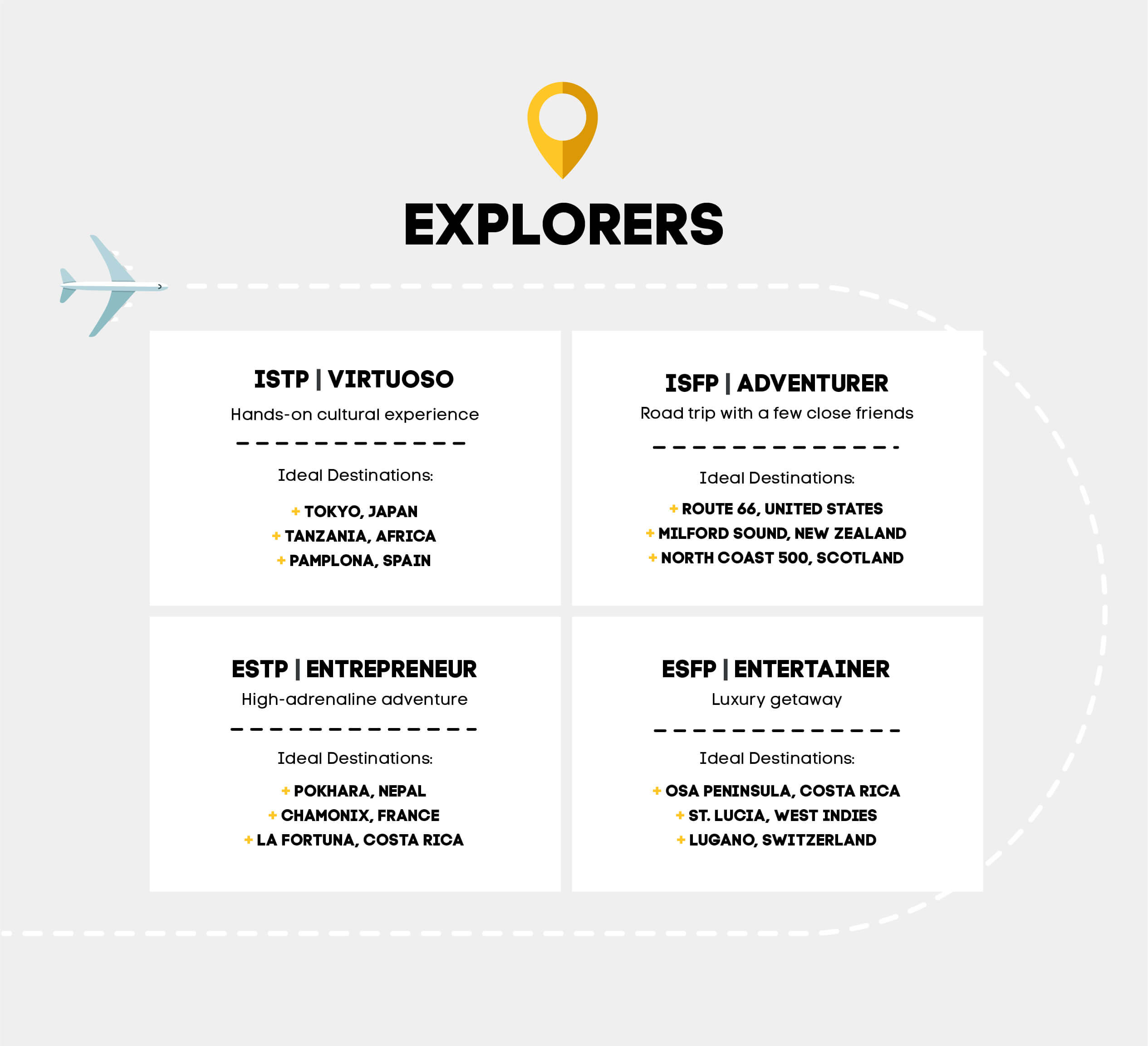
ISTP / Virtuoso
As an introvert, you value time away from crowds of people. It’s best to travel solo as your alone time is what helps you re-energize and gives you the freedom to explore as you please. If you’re bringing a travel companion, make sure it’s someone who’s alright with giving you your space. While you don’t need to plan much, you should look into hands-on opportunities to dive into other cultures, like learning a native art form, eating a traditional meal, or attending a holiday event.
Where ISTP should travel: Hands-on cultural experience
- Tokyo, Japan — Tsukiji Market, Harajuku, Ryōgoku
- Tanzania — Tanzanite Experience, Serengeti Safari, Iraqw Village
- Pamplona, Spain — Plaza de Toros de Pamplona, San Fermin Festival, Camino de Santiago
ISFP / Adventurer
Planning is not your strength and you should embrace that. You can easily buy a plane ticket on a whim or hop in the car and set off on an adventure. You enjoy connecting with people, so bring a few good friends along for the ride. But being around people requires a lot of your energy. To make sure you don’t feel too drained, get some alone time, or at least set quiet time for the group so you can collect your thoughts.
Where ISFP should travel: Road trip with a few close friends
- Route 66, United States — Barringer Crater, Henry’s Rabbit Ranch, Lincoln’s Tomb
- Milford Sound, New Zealand — Te Anau, Eglinton Valley, Lake Gunn
- North Coast 500, Scotland — Dunrobin Castle, Smoo Cave, Duncansby Head
ESTP / Entrepreneur
You don’t need to make too many plans for your vacation — you’re fine with taking risks and you’re good at figuring things out as you go. Travel with a band of adventurous pals or meet up with an organized group so you won’t be alone during your trip. Find a destination with many outdoor activities like surfing, kayaking and canyoning that will push your limits and keep your adrenaline pumping. If you want the thrill without the hassle of organizing everything yourself, a luxury surf vacation can be a great fit — someone else handles the logistics while you focus on catching waves and pushing your boundaries.
Where ESTP should travel: High-adrenaline adventure
- Pokhara, Nepal — Bungee jumping, paragliding, Himalayan trek
- Chamonix, France — Ice climbing, riverboarding, mountain climbing
- La Fortuna, Costa Rica — Surfing, zipline through the jungle, canyoning
ESFP / Entertainer
Treat yourself to a luxury vacation with a couple of friends. Head to a place with perfect weather and great views where you can sit back and indulge in the finer things. Plans aren’t important since you’ll be relaxing most of the time. But make sure you’re able to hit a few parties or social gatherings where you can do what you do best — entertain the masses and make lots of new connections.
Where ESFP should travel: Luxury getaway
- Osa Peninsula, Costa Rica — Beaches, coffee tours, boat tours
- St. Lucia, West Indies — Sailing, helicopter tours, beaches
- Lugano, Switzerland — High-end shopping, lakeside villas, Swiss and Italian cuisine
How Every Personality Type Experiences Kalon Surf
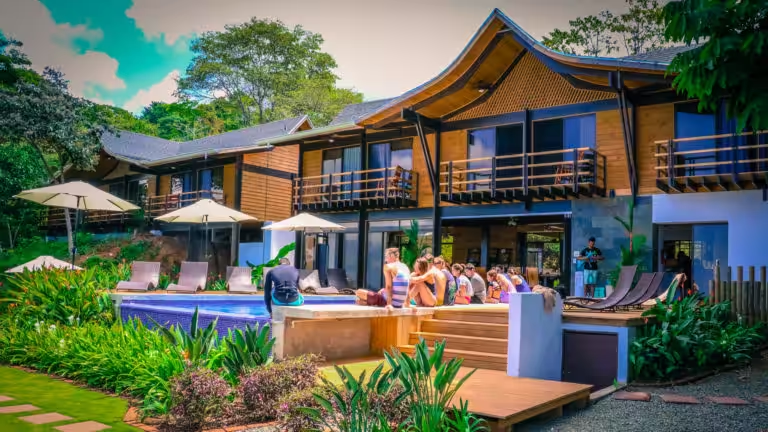
We see all 16 personality types walk through our doors — and that’s by design. Kalon Surf is small (just 10 rooms), all-inclusive, and structured enough to give every day a rhythm, but flexible enough that you can make the week your own. Here’s how the four personality dimensions tend to play out during a week at Kalon.
Introverts and Extraverts. About 60% of our guests come solo, and many of them are introverts who want a week away from the noise. The resort is social — you’ll share meals, surf together, and spend time at the pool — but it’s never a party scene. Evenings are about good food and easy conversation, and there’s always the option to grab a book, sit on your private balcony, or walk our jungle trail when you need space. Extraverts, on the other hand, thrive on the group dynamic: sharing waves, swapping stories over dinner, and making friendships that tend to stick long after the week is over.
Sensors and Intuitives. Sensors love Kalon because the week is tangible and grounded. You wake up, have breakfast, surf, eat lunch on the beach, relax by the pool, watch the sunset, have a three-course dinner. Every day has a satisfying physical rhythm to it. Intuitives tend to connect more with the bigger picture — the personal growth that comes from learning something completely new, the perspective shift that happens when you slow down for a full week, and the conversations that come out of spending time with interesting people from all over the world.
Thinkers and Feelers. Thinkers appreciate the methodology behind our coaching. We use video analysis, a 3:1 guest-to-coach ratio, and a structured progression system — it’s not just “go catch a wave.” There’s technique, ocean reading, and measurable improvement, which thinkers find deeply satisfying. Feelers are drawn to the human side: the relationships with our Costa Rican staff, the family-style dinners around a shared table, and the connections they build with other guests. Many of our repeat visitors (we have guests who’ve come back 10, even 15 times) are feelers who come back as much for the people as for the surf.
Judgers and Perceivers. This is one of the things we hear about most. Judgers love that everything is handled — from the airport pickup to the daily schedule to the meals. There’s nothing to plan, nothing to figure out, and no logistics to manage. They can fully relax because the structure is already there. Perceivers love it for the opposite reason: because everything is taken care of, they don’t have to plan anything either. They just show up and let the week happen. Both types get exactly what they need, which is rare for a vacation to pull off.
Where Will You Go?
As Gretzel explains, people often have difficulty describing who exactly they are but it is much easier for them to state who they are definitely not.
So if the Myers-Briggs types and destination suggestions don’t sound like you or what you enjoy, consider what options they eliminate instead. This alone might help you plan out a dream vacation.
“However, a lot of travel is also transformative and about discovery, about pushing one’s boundaries,” Gretzel says. “So, sometimes it can be worthwhile thinking ‘beyond one’s personality’ and trying something a little different.”